Countless American college students between the ages of eighteen and twenty-three passed through my classrooms during my more than fifteen years as a Spanish instructor in the United States. Making a quick mental calculation, I can assume there were probably around two thousand young people whom I taught in that time. I had all kinds of students: good, bad, and so-so; most of them of Anglo-Saxon origin, but I also had African American, Asian, Hispanic, and international students in my classes. There were students of every kind—from those who took Spanish only to fulfill an academic requirement to those whose lives were changed by learning a new language. In general, they were all relatively serious students, as it was an expensive university.
However, despite what is often said in politics or in the media, my experience showed that most American college students ended their courses with a genuine appreciation for the Spanish language and for Hispanic culture in general. Most students chose to continue studying Spanish in higher education after beginning in high school. They started out attracted by the food and ended up falling in love with the culture. Many wanted to keep learning after the course ended and even considered traveling to Latin America or Spain before finishing their university studies.
Most of my courses focused on teaching the language—from the basics to more complex rules. But in a few of the more advanced classes, I had the opportunity to go beyond grammar and delve into Spanish literature with passages, essays, and short stories by some of the most outstanding contemporary authors. Considering that, for these students, Spanish was their second or third language, the ability to read in a tongue that was not their “mother” language was, naturally, more challenging.
In my experience, when reading the “great” and the “consecrated,” Federico García Lorca was immediately liked for his frankness and eloquence when we read excerpts from Blood Wedding or The House of Bernarda Alba. Carlos Fuentes resonated deeply with almost everyone—especially with the “heritage speakers” of Latin American background—because his essays often addressed identity, which made them feel immediately represented. The stories of Isabel Allende, Ángeles Mastretta, and Elena Poniatowska were perennial favorites, especially among women, due to their sensitivity, nostalgia, and captivating language. Gabriel García Márquez, though one of the greatest, was challenging for students because of his many colloquialisms and regionalisms. Meanwhile, Vargas Llosa—although extraordinary, in my opinion—was sometimes perceived as a little “pretentious.” However, the short stories of Arturo Pérez-Reverte and Edmundo Paz Soldán were widely enjoyed because they were easy to understand and addressed contemporary issues without delving too deeply into cultural intricacies.
Despite being more complex, many students found great fascination in Jorge Luis Borges, especially in his laborious narratives and metaphors that invited reflection. “Emma Zunz” was one of their favorite stories. They also found Augusto Monterroso and his micro-stories captivating. By the end of the course, we read Julio Cortázar, which for many students “blew their minds.” For others, Cortázar was simply too complex—difficult to understand and analyze. I don’t blame them; Cortázar’s most important novel, Hopscotch, is still one of the most complex books I have read so far.
One can read that novel in several ways: following the traditional order from beginning to end, skipping chapters according to Cortázar’s “table of instructions” (reading sequentially from chapters 1 to 56 and dispensing with the rest, or starting at chapter 73 and continuing in the order suggested), or reading in free form, jumping through fragments in different directions.
Julio Cortázar (1914–1984), Argentine novelist, short-story writer, essayist, and translator—later naturalized French—is one of the most important representatives of the Latin American Boom. He is possibly one of the most innovative and original authors of his time, a master of prose and of the short story. He broke classical molds and inaugurated a new way of writing literature with multiple narrative perspectives that challenged the temporal linearity of traditional fiction. Cortázar became notable for his numerous short stories, collected in volumes such as Bestiary (1951), End of the Game (1956), and The Secret Weapons (1959), establishing himself as one of the greatest storytellers of the twentieth century. His stories often include fantastical or mythical elements; protagonists who begin in ordinary situations but end in strange or terrifying circumstances; and bold jumps in time from one paragraph to the next.
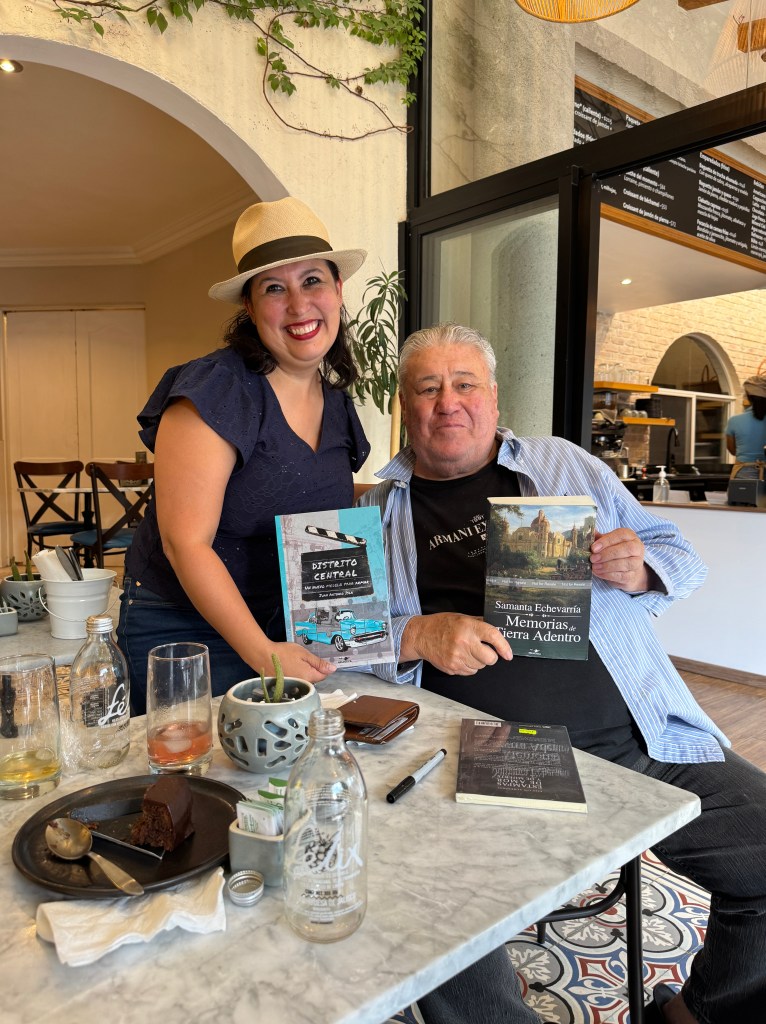
This summer I was in Querétaro, Mexico, my hometown, to present my first novel, Memorias de Tierra Adentro. At the end of my stay, I had the opportunity to chat with the writer Juan Antonio Isla, who is also originally from Querétaro. Although I had known of him since childhood—through his friendship with my parents and because we are from the same town—I had never had the chance to chat with him in person. Very kindly, he invited me for a cup of coffee and a delicious slice of cake in a lovely café near the striking Querétaro aqueduct. He gifted me two of his books and signed them on the spot—a great honor. I began reading one of them immediately; I read the second upon arriving home in the United States.
Under the Almond Trees: Prints of Love and Death (Editorial Siglo XXI, 2017) was the first. I enjoyed it immensely because it combined two of my favorite subjects: historical fiction and the city of Querétaro. I read it in two days without stopping. It is a story based on true events about two rival families during the Mexican Revolution. I loved the histories behind the monument to La Corregidora (which I have walked past countless times), the story of the city’s modernization, and the tale of the first car in town. In this book, in my opinion, Juan Antonio Isla establishes himself as a true “Master of the Querétaro Novel.”
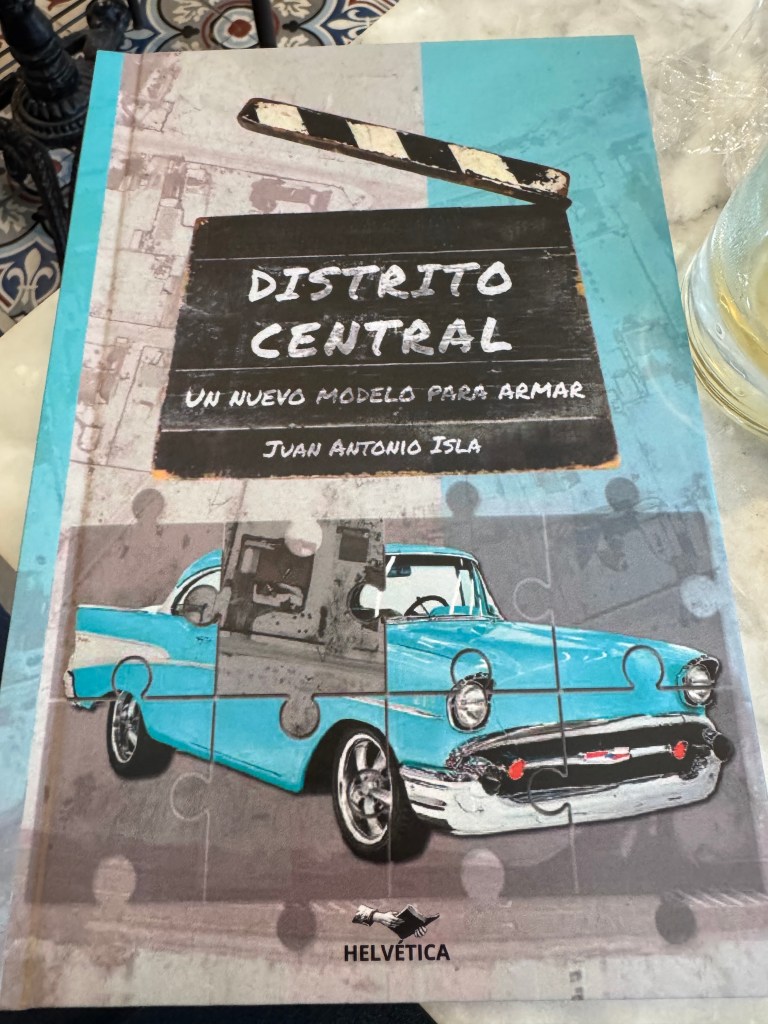
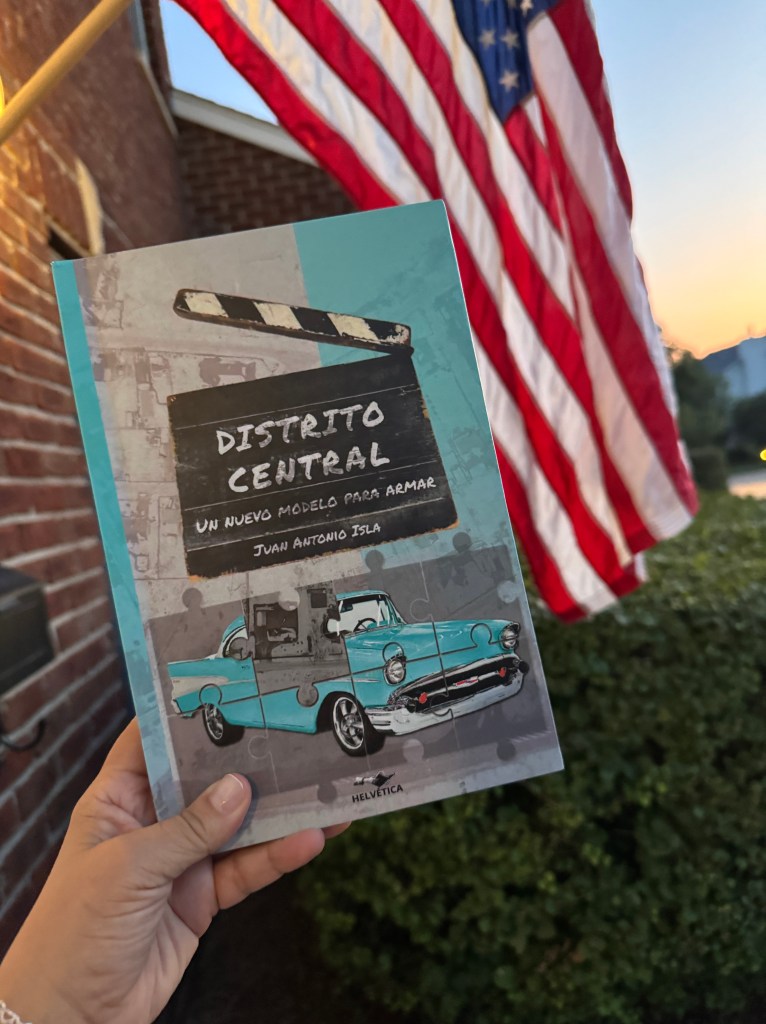
Later, upon returning home, I read his latest book, Central District: A New Model to Assemble (Editorial helvética, 2024). I was fascinated by it. Set in the 1950s, the novel is a circular narrative composed of story fragments arranged in a documentary style in the fictional town of Distrito Central—an allusion to Querétaro. The novel invites the reader to assemble their own version of the story. Some passages are humorous, others raw; many have a strong sexual charge, making it a book for adults (surprising, given its portrayal of a conservative town). Yet all are magnificently narrated. It is difficult to read in one sitting; it must be read slowly, and sometimes reread, to avoid losing the thread.
Isla’s narrative style reminds me quite a bit of Carlos Fuentes, but the novel’s complexity is more akin to Cortázar, as Isla often embeds stories within stories. This intentional “chaos” is precisely the effect the author seeks. The book is full of characters, and yet each serves a purpose. Central District reminded me of Cortázar’s Hopscotch, where the reader can jump from one part to another, start in the middle or at the end—much like the children’s game of the same name—or like those “Choose Your Own Adventure” books I read in the eighties, but in a far more sophisticated way. A book of this nature is difficult to achieve, and it speaks to an author who is a master of narrative with great experience.
Distrito Central: Un Nuevo Modelo para Armar
(Editorial helvética, 2024) ★★★★★
(Spanish edition)
The book is available on Amazon.

 luna negra, revista literaria
Deja un comentario