
By Samanta Echevarría
The charm of Querétaro as a jewel of Mexican baroque architecture is undeniable. Its streets, fountains, and pink quarry buildings, as well as its temples and altarpieces adorned in the Churrigueresque style, make this colonial city one of the most beautiful in Mexico. I grew up there. However, its importance has not lain in its beauty itself, but in its location. Historically, it has been a strategic point within the territory of what is now Mexico. Precisely because it is located in the heart of the country, Querétaro has been a crossroads of paths and encounters. Since the viceregal period, it functioned as a crucial point for the trade and supply of New Spain, and by the eighteenth century, it was considered the third most important city in Latin America, after Lima (Peru) and Mexico City.
This strategic location made Querétaro the scene of important historical feats: it was the cradle of Mexico’s independence, the center of its conspiracy, and a key site for the beginning of the armed struggle. Later, it witnessed the end of the Second Empire with the trial and execution of Maximilian of Habsburg. In the twentieth century, it became the headquarters of the Constituent Congress that signed the Mexican Constitution of 1917.
Rodrigo Romero, researcher and PhD in History from the Faculty of Philosophy and Letters at UNAM, points out that, since its beginnings, the historical feats of the Mexican state have been the subject of study and numerous interpretations. Mexican historiography evolved from post-independence chronicles and pamphlets to monographic approaches to the epic and heroic deeds that served as the foundation for consolidating Mexican national identity.
The foundations of Mexico’s history have been laid by numerous researchers, ranging from The History of the Revolution of New Spain by Servando Teresa de Mier (London, 1813), to Mexico through the Centuries by Julio Zárate; from Historical Picture of the Mexican Revolution by Carlos María de Bustamante, to Historical Essay of the Revolutions of Mexico by Lorenzo de Zavala; from Mexico and Its Revolutions by José María Luis Mora, to History of Mexico by Lucas Alamán, and the works of Justo Sierra and José Vasconcelos, to mention just a few.
However, as time has passed, Mexican historiography has evolved from a vision centered on “the people versus the foreign power” to a broader understanding of these armed movements—one that includes more complex social, economic, regional, and international factors, as well as the participation of many figures about whom we still know little.
Romero affirms that although earlier efforts had appeared in the past, it is likely that the 1953 publication commemorating the bicentennial of Miguel Hidalgo’s birth—The Revolution of Independence by Luis Villoro—marked the beginning of this new historiography. Yet it was not until later, in the 1990s and especially after 2010 with the bicentennial of Mexican Independence, that researchers began to rethink Mexico’s national history.

One of these new voices is undoubtedly that of Jesús Reyes Bustos (b. 1972), an anthropologist from the Autonomous University of Querétaro, who, although originally from Mexico City, has deep roots in Querétaro. Reyes Bustos has gone beyond historical research; he explains that he has dedicated himself to writing historical novels in order to “take science out of the archives, the academy, and the technical terms, with the intention of disseminating it and making it more accessible to readers and to society in general.”
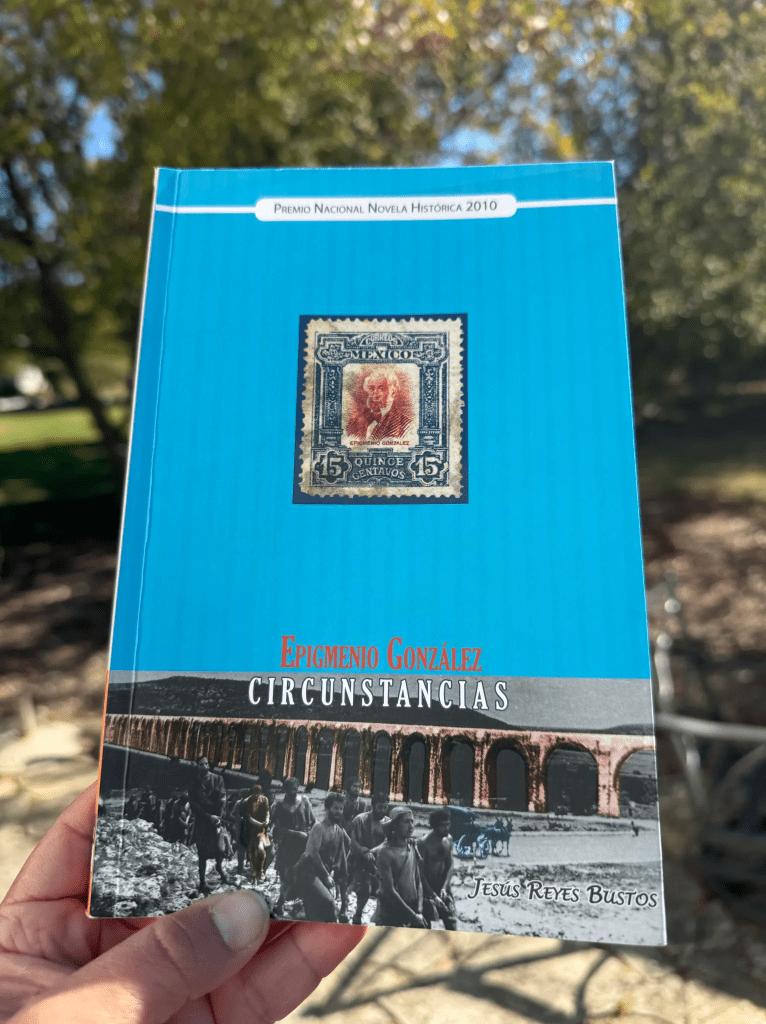
In 2011, he independently published his first novel, Epigmenio González. Circunstancias (El Asado Servicios Editoriales), which earned him Mexico’s National Award for Historical Novel in 2010. The novel explores the extraordinary life of Epigmenio González, who, upon joining the Querétaro conspiracy at the beginning of Mexico’s Independence, was one of the first insurgents apprehended by Spanish royalist authorities—and also one of the last revolutionary leaders to be released by the Spanish Empire, even after the consummation of Independence. After having spent more than 25 years imprisoned in the Philippines, and several more in the fortress of San Juan de Ulúa in Veracruz, he managed to return to Mexico and died peacefully in his bed in 1858.
I came across the wonderful work of Jesús Reyes Bustos while researching my own novel Memorias de Tierra Adentro. I was immediately captivated by his novel Circunstancias. Later, with the publication of my book, our paths crossed, and Reyes Bustos and I have kept in touch through social media and text messages.
In a halting telephone conversation from Mazunte, Oaxaca—his current residence—he tells me, “I’m in paradise, but with little internet signal.” He explains that his novel Circunstancias arose from the enormous amount of information he gathered during his doctoral thesis. “I didn’t want the life of Epigmenio González—this extraordinary man who suffered so much for Mexico—to be reduced to my PhD thesis and then re-archived. I thought this amazing Queretano deserved recognition from society. I decided to novelize my academic research to make his story known. Because he wasn’t an Allende or a Hidalgo, his extraordinary story of survival was left aside and forgotten by national history. During the cultural movement of Juárez and the liberals at the end of the nineteenth century, when the Mexican nation-state was being built, Epigmenio González was still miraculously alive in Guadalajara, and his story didn’t fit into the ‘Civic Calendar of Saints’ of patriotic heroes. He never received the recognition he deserved.”
Reyes Bustos has published two more novels. In 2013, he presented La Quimera Imperial at the Center of the Arts of Querétaro (formerly the Convent of Santa Rosa de Viterbo). Its premise revolves around “Operation Peacock,” a plan to bring Moctezuma’s Plume from Austria to Mexico in exchange for Maximilian of Habsburg’s carriage, which is housed in Chapultepec Castle. In this second work of historical fiction—part detective story—Reyes Bustos moves away from academic language and integrates elements of suspense into his plot.
In his third novel, De esas Sombras Frente al Puerto (2018), Reyes Bustos returns to Querétaro as the setting. He employs the racconto (a narrative device in which a story is told retrospectively) to develop a plot set during the Constituent Congress of Querétaro in 1917 and the days preceding the assassination of Venustiano Carranza. The story unfolds amid the intrigues of the congressmen in the Iturbide Theater (today the Theater of the Republic) and the Cantina El Puerto de Mazatlán, where the new Mexican constitution was being shaped.
All three novels are extraordinary. I highly recommend reading his work. Jesús Reyes Bustos continues to write, driven by the intention of giving Epigmenio González the place he deserves in Mexico’s national history.
Reyes Bustos won Mexico’s National Award for Historical Fiction (2010) for his novel Circunstancias and has received other distinctions: First Place in University Short Story (UAQ, 2003); First Place in Short Story (Conaculta, Gómez Morin, 2005); and Honorable Mention in the Spanish-language category of Letras Nómadas (Tulsa, Oklahoma, 2007). He has also been a columnist for El Universal Querétaro and the Sunday supplement Barroco of Diario de Querétaro. He currently resides by the beach in Oaxaca.
Epigmenio González. Circunstancias, by Jesús Reyes Bustos ***** (Spanish edition)
 luna negra, revista literaria
Deja un comentario