
By Samanta Echevarría
My father always loved the seventh art. He enjoyed Mexican cinema, especially that of its golden age, but he also admired international cinema. When I was a little girl, he often spoke about the famous international movie stars of the 1960s, such as Marcello Mastroianni, Alain Delon, Sophia Loren, Brigitte Bardot, and Claudia Cardinale, among many others. During his youth, he saw all these films in the theaters of Mexico City. Most of these cinematic works became classics over time. He would recount them in such detail that, when he did, we felt as if we had seen them with him during that golden age of cinema.
In my adolescence and youth, inspired by those narratives, I watched some of those films— not all, but a good number of classics. I owe my father that knowledge of international and classic cinema, which was uncommon among teenagers of my age in the 1990s. Some of the films that impacted me most back then were:
- La Dolce Vita (1960), with Marcello Mastroianni — about the lives of tabloid journalists in Rome, the famous “paparazzi” (a word the film made famous).
- Psycho (1960), with Anthony Perkins — turned into a cult classic of horror by the superb director Alfred Hitchcock.
- Il Sorpasso (1962), with Vittorio Gassman — one of the first “road movies,” about a student who travels from Rome to Tuscany.
- The spectacular and epic Lawrence of Arabia (1962), with Peter O’Toole and Anthony Quinn — based on the life of T. E. Lawrence and his memoir The Seven Pillars of Wisdom.
- Dr. Strangelove (1964), directed by Stanley Kubrick — a black comedy that satirizes the Cold War.
- Zorba the Greek (1964) — a film that brought fame to Anthony Quinn and to the exuberant Greek dances.
- The Good, the Bad and the Ugly (1966) — one of the celebrated “Spaghetti Westerns,” directed by Sergio Leone and starring Clint Eastwood as “the Good,” Lee Van Cleef as “the Bad,” and Eli Wallach as “the Ugly.”
There were also several musicals, such as West Side Story (1961), Mary Poppins (1964), and The Sound of Music (1965), to name just a few—the list is endless.
All these films are magnificent; however, my favorite old movie is a bit older: Roman Holiday (1953), starring Audrey Hepburn and Gregory Peck. It tells the story of a princess who escapes her royal life for an adventure through the streets of Rome. I can watch this movie over and over again and still enjoy it just as much.
The film my father always spoke of as one of his favorites, also from 1951, was A Streetcar Named Desire. Directed by Elia Kazan and starring a young and handsome Marlon Brando, it tells the story of a Southern belle, Blanche DuBois, who, after a series of personal misfortunes, takes a streetcar named “Desire” to New Orleans to live in a modest apartment with her sister, Stella, and her brother-in-law, Stanley. Her arrival provokes chaos and tension, leading to a dramatic triangle among the characters. Blanche urges her sister to leave her alcoholic husband.
The film is based on the 1947 Broadway play of the same name, one of the most acclaimed of the 20th century and winner of the Pulitzer Prize. It was written by Thomas Lanier Williams III, better known as Tennessee Williams. The iconic scene where Brando cries “Stella!” has become a classic of classics, endlessly adapted and parodied—even by The Simpsons.
A Streetcar Named Desire regained relevance with my generation in the late 1990s, when Spanish director Pedro Almodóvar referenced it in his film All About My Mother. The reference is essential to Almodóvar’s film, as the play becomes a thematic thread that expresses solidarity among women who support one another through pain and adversity.
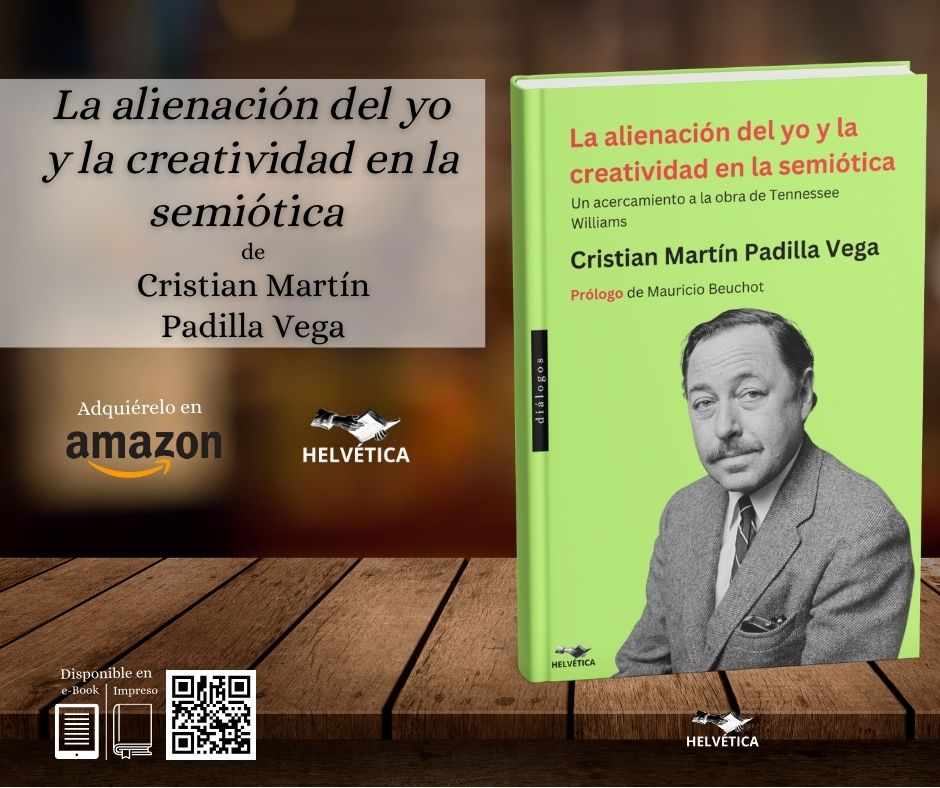
I met Dr. Cristian Martín Padilla Vega this summer in Querétaro, during the editorial presentation of his book The Alienation of the Self and the Creativity of Semiotics (published by Editorial Helvética). The first thing I asked myself when I was invited to this event was: What on earth is this book about? My mother and I discussed it.
“I remember semiotics—syntax, semantics, and pragmatics,” I told her.
She replied, reading from her phone: “Semiotics is the study of signs, symbols, and meaning—that is, how symbols and nonverbal language are interpreted by the brain. It’s fundamental to understanding human communication and the way we interact with the world. For example: graphic symbols, traffic signs, musical notation, and so on.”
Intrigued, we went to the presentation, which took place a few days before my own book Memorias de Tierra Adentro was presented. What I hadn’t noticed until arriving at Padilla Vega’s book signing at Galería Libertad (in the historic center of the beautiful colonial city of Querétaro) was the subtitle: An Approach to the Works of Tennessee Williams. Suddenly, everything made sense.
My interest in the subject was immediate. I began reading the book that same evening at my mother’s house—and devoured it in one sitting.
Because of my love for classic cinema, I was fascinated by this book. Based on his doctoral thesis and with a prologue by Fr. Mauricio Beuchot (Torreón, Coahuila, 1950)—one of the foremost contemporary philosophers of Ibero-America—Padilla Vega analyzes and dissects the work of Tennessee Williams through the lens of semiotics. Moreover, he goes even further, exploring how Williams’s tragic life—his sister’s schizophrenia, his homosexuality, and his addictions—influenced his work.
The book demonstrates academic rigor without being dull; it is profound and invites reflection. Reading it makes you want to revisit all the classic films based on Williams’s works, analyzing them from a new perspective and unraveling the complex drama of his characters. I found the book truly engaging. Turning this academic research into a literary narrative was an excellent idea.
Padilla Vega writes:
«For the semiotic study of Williams’s work in cinema, and for the analysis of the seventh art in general, it is necessary to address the cinematographic discourse and understand the elements that create it, as well as its insertion in the imaginary and in the collective unconscious» (Helvética, p. 50).
«Both at the individual and social level, when there is awareness of suffering… the possibility arises of taking responsibility for that pain, for that adverse or tragic condition, and of channeling it toward the sublime» (ibid., p. 135).
Cristian Martín Padilla Vega is also a poet and the author of several works in Spanish: La emancipación del aire (UAQ, 2009), La guitarra y el mar (La Testadura, 2013), El migrante perdido and Diles que no te maten (La Testadura, 2015), Instrucciones para manejar el abandono (UAQ, 2016), and El cuerpo de la vida (UAQ, 2020).
The Alienation of the Self and the Creativity of Semiotics: An Approach to the Work of Tennessee Williams by Cristian Martín Padilla Vega (Helvética, 2025)
***** (Spanish edition)
Available on Amazon.


Deja una respuesta